- ▸ Fish Road RTP is 96.00%, flat across all four modes, for a house edge of roughly 4%.
- ▸ The real top prize is a hard $20,000 per-round cap, not the marketed x2,542,251 multiplier.
- ▸ At the $200 max bet the cap binds at just 100x, so the seven-figure figure is unreachable in cash terms.
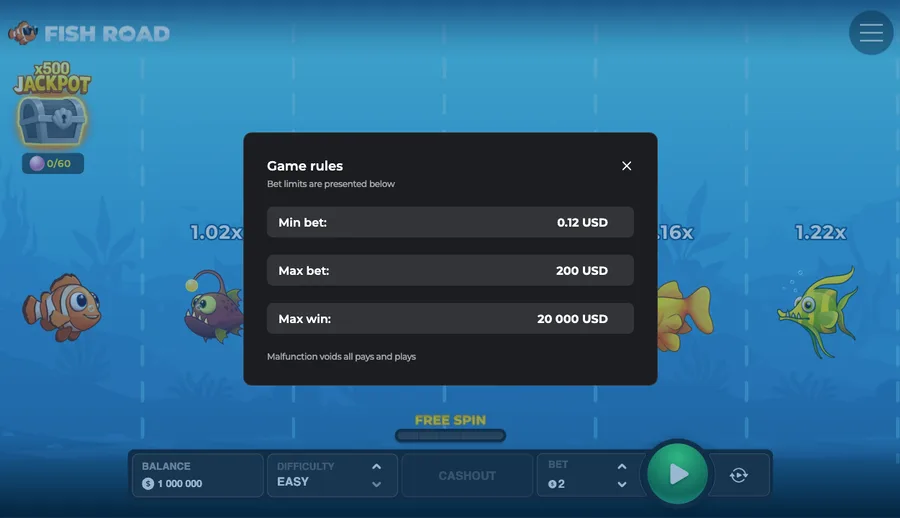
- ▸ Bets run $0.12 to $200; operators can configure a reduced RTP model, so check which build a casino serves.
Reviewed game
 Fish Road (InOut Games)
Play the game
18+ | T&C apply | Play responsibly
Fish Road runs a 96% RTP with a house edge near 4%. The top multiplier scales by mode, from about x25 on Easy to a theoretical seven figures on Hardcore, but a hard $20,000 per-round cap is the number that actually decides your biggest win. Here is what the maths mean for a real session.
The Maths In One Paragraph
You get an RTP of 96.00% (2026 build), a house edge of roughly 4%, and a real top prize of $20,000 per round. This is the step-multiplier crash game InOut released in October 2025, and for crash-game players comparing titles that flat 96.00% is the headline spec. That flat 96.00% holds across all four difficulty modes, so the mode you pick changes the shape of your risk, not the long-run return. The headline you'll see quoted elsewhere is a multiplier of up to x2,542,251 on Hardcore, but a hard cash cap sits well below it. Before you chase that seven-figure number, read the max-win section below, because it changes the whole picture. Indian players should note one thing up front: at India-facing casinos you bet and cash out in ₹ (INR), but the provider's figures below are quoted in USD, and we don't convert them to a fixed rupee rate. If you just want to see the board move, try it in the free Fish Road demo first. For the full write-up, our Fish Road review pulls the maths, the modes and the verdict together.
Key Takeaways
What The 96.00% Fish Road RTP Actually Buys You
RTP is a long-term theoretical figure, not a promise for your session. Over a very large number of rounds the game is built to pay back about 96 cents of every dollar staked, which leaves the house roughly $4 in every $100. On a single night you can walk away up a lot or down a lot, and neither result tells you the RTP is wrong.
Here's the part operators don't advertise. The 96.00% is the default published figure (1), but the InOut engine lets operators run reduced RTP models. A sibling crash game in the same stable ships at 95.5%, and there's no rule forcing every venue to serve you the full 96.00%. No specific lower Fish Road decimals are published anywhere we could verify, so we won't invent one. What we will say is this: if a casino runs a trimmed model, your real edge is worse than the number on the box, and you have no easy way to see it from the game screen.
Provably fair covers the fairness of each round's draw, not the payout percentage. The two things are separate. You can confirm a round wasn't tampered with and still be playing a reduced-RTP build. If that worries you, our provably fair page walks through exactly what the commit-reveal system does and does not guarantee.
The Max-Win Truth
The RTP tells you the long-run return, but the number that actually caps your night is the max win. This is the section that matters most, and it's the one affiliate spam gets wrong. Fish Road advertises enormous per-mode multipliers, topping out near x2.5 million on Hardcore. Those numbers are real as multipliers. They are also almost useless, because a separate rule caps what you can actually collect.
The in-game Game Rules panel states a maximum win of $20,000 per round, alongside a minimum bet of $0.12 and a maximum bet of $200 (2). That cap is the true ceiling. Whatever multiplier the clownfish reaches, your win is paid out only up to $20,000, and no further. At an India-facing casino that ceiling is converted to ₹ (INR) at the operator's rate, but the provider figure stays fixed at $20,000.
Per-Mode Top Multiplier (Up To / Around)
- Easy: up to x25
- Medium: around x2,500
- Hard: around x52,067
- Hardcore: up to x2,542,251
Why The Seven-Figure Multiplier Is Unreachable
With the cap stated, a little arithmetic shows why the marketed multiplier can't pay out. Do the arithmetic and the mirage falls apart. The $20,000 cap and your bet size together fix the highest multiplier you can ever bank. Divide the cap by your stake and you get the effective ceiling.
| Your bet | Cap ($20,000) hits at | Effective multiplier ceiling |
|---|---|---|
| $200 (max) | $20,000 | 100x |
| $40 | $20,000 | 500x |
| $4 | $20,000 | 5,000x |
| $0.12 (min) | $20,000 | ~166,666x |
At the $200 maximum bet the cap binds at just 100x. So the x2,542,251 Hardcore figure isn't merely hard to hit, it is mathematically off the table at max stake. Even at the $0.12 minimum bet the cap caps you around 166,666x, still far short of the marketed number. There is no bet size at which the seven-figure multiplier pays a seven-figure sum, because it can't. The most you take home in any single round is $20,000, full stop. With the ceiling settled, the other number that shapes your session is volatility, and it swings hard by mode.
Volatility, Mode By Mode
Since the ceiling is fixed, the thing that varies your ride is volatility. The RTP stays flat at 96.00%, but the variance does not. Fewer steps in a mode means a steeper multiplier climb and a shorter fuse. Pick your mode by how much swing your bankroll can absorb, not by the top number.
Easy (24 steps)
Low volatility. Small, frequent multipliers, gentle drawdowns. The steadiest way to learn the loop, and the mode where a modest bankroll lasts longest.
Medium (22 steps)
Medium volatility. A noticeable step up in swing, with a ceiling near x2,500. A middle ground if Easy feels flat.
Hard (20 steps)
High volatility. Rounds end early far more often, though the surviving runs pay hard. Expect long dry stretches.
Hardcore (15 steps)
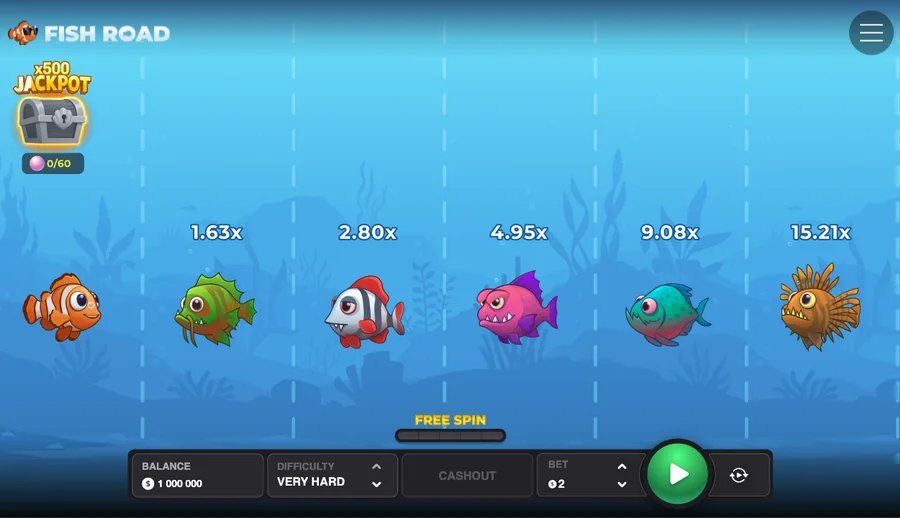
Extreme volatility. The predator ends most rounds fast. This is where the huge multipliers live, and where a bankroll evaporates quickest. Small stakes only.
What The Swing Means For Your Bankroll
Higher volatility doesn't change your expected loss over time, it just changes how you get there. On Easy the losses trickle. On Hardcore they arrive in bursts, and so do the wins. If you've set aside a modest session budget, that money survives a lot longer on Easy at small stakes than on Hardcore. When we loaded the demo, the Hardcore rounds ended early far more often than not (a small, unscientific sample), which lines up with the extreme-volatility label. You can watch the same pattern yourself, no money down, in the free Fish Road demo. For the mechanics behind each mode, see how the difficulty modes work.
Bet Range, And How Stake Meets The Cap
Volatility decides how the ride feels; your stake decides how the cap bites. The Game Rules panel sets the range at $0.12 to $200 (2). Individual operators can tighten those limits, so your India-facing casino may not offer the full spread, and the ₹ (INR) figures on screen are the operator's conversion of these USD limits. That range does more than set your minimum buy-in. It quietly decides your real multiplier ceiling, as the cap table above shows.
Bigger bets aren't "better" here. A $200 stake caps you at 100x. A $4 stake lets a lucky run pay up to 5,000x before the cap bites. If your goal is a huge multiplier, you want a small bet, not a big one. If your goal is a bigger cash figure per successful round, you want a bigger bet, and you accept the 100x ceiling that comes with it. There's no bet that gives you both.
The Two Levers You Control
- Stake size: sets your cash win per round and your effective multiplier ceiling.
- Mode: sets your volatility and how fast the multiplier climbs.
Honest Cons On The Fish Road RTP And Cap
The numbers are fair, but they aren't the best in the genre, and it's worth being blunt about that. 96.00% is only average. It reads fine in isolation, but the genre headliner from the same studio runs at 98.00%, which is a meaningfully better long-run deal on the same style of game. On RTP alone, Fish Road doesn't lead its own category.
The bigger gripe is the marketing. Plastering an x2,542,251 multiplier across the promo is misleading when the $20,000 cap makes it unreachable at any realistic stake. We wouldn't grind Hardcore hoping for the seven-figure payout, because the cap makes that goal impossible, not just unlikely. Treat the top multiplier as a slogan, not a target.
One named anti-recommendation: we can't recommend playing at any operator running a reduced RTP model below the published 96.00%. You often can't see it from the game screen, so if a casino is opaque about which build it serves, that's a reason to walk. Stick to venues that publish the standard figure. Fish Road runs at licensed online casinos that carry InOut Games titles - search the lobby, availability varies by region and operator, 18+.
The drawback in one line, and who should skip it. If your whole reason for playing is the seven-figure jackpot fantasy, this game isn't for you and you should avoid it, because the cap makes that prize impossible rather than merely unlikely.
Bottom Line On The Maths
Fair but unremarkable. The 96.00% RTP is honest and flat across modes, the provably fair layer lets you audit each draw, and the $20,000 cap is at least stated plainly on the Game Rules panel. Just play it for what it is. Pick a mode that fits your bankroll, set a small stake if you're chasing a big multiplier, and ignore the seven-figure headline entirely. Curious how it plays out? Load the game in the Fish Road demo and watch the cap logic for yourself.